Monday, November 21, 2005

How do you like them APPlES?

In the spirit of Thanksgiving, I wish to thank the Donut Shop on 7th Ave here in Park Slope, Brooklyn, for giving me this perfect example of improper lowercase L usage. Strangely enough, this is the second time we've seen a lowercase L used when spelling APPlES. Perhaps the word "apple" reminds the writer of apple pies, so he subconsiously changes the L to look like an i in PIE. Or maybe he's thinking of "apple of my eye", which sounds like "apple of my i". Or maybe the guy just had too much of the "sweet pot".

Either way, happy Thanksgiving!
Monday, November 14, 2005

From the Dept. of PSYCHOlOGY

In response to some questions I had about the psychology behind the lowercase L phenomenon, friend and Research Fellow in Neuropsychology, Bart D. Brigidi, Ph.D. agreed to an interview and allowed me to publish in the article below.

lowercase L: What do you think of this lowercase L business?

Dr. Brigidi:
The lowercase "l" is an interesting occurrence and maybe not as understudied as one would think. From a neuropsychological perspective, errors in writing fall under the umbrella term of dysgraphia, which means that somene has a writing disability or disorder -using the Latin dys which means "a difficulty with" and graphia which means the act of writing. Dysgraphia is not uncommon for individuals with aphasia or childhood learning disorders. It usually refers to inconsistencies in letters, irregular letter sizes and shapes, mixing case or cursive with print, and incomplete or unfinished letters. This type of deficit must be out of sync with the person's intelligence level and rarely occur in isolation outside of other learning impairments such as dyslexia. Very important is that dysgraphia must be differentiated from laziness, too.


But why does dysgraphia occur?

Yes. The why. I knew that was coming. Recent thought about the "why" of switching case has pointed to the potential role of faulty inhibitory mechanisms in the brain. For the lowercase "l" phenomenon, this would mean that someone was unable to inhibit the intrusion (unwanted thought) that a lowecase "l" was correct. Then after writing this error, it becomes an issue of awareness followed by the issue of what to do with the error if it is noticed. Given awareness and why someone would not change the error, who knows, I would guess time contraints, laziness, "good enough" mentality, not having an eraser, or some combination of all these would factor in to why the error is not changed. Aphasic patients can have interesting dissocations in the neural circuits governing writing and speaking, so that is a population that has traditionally been studied with respect to this phenomenon.


How common is the lowercase L syndrome?

How often does this happen is a good question. Short answer is I am not sure. And I am not sure its prevalence is known. However, it is thought to occur at least as often as reading disorders, which would mean that dysgraphia, in all its forms, occurs in approximatley 4% of the population. This is a low baserate phenomenon,and the percentage of people specifically exhibting the lowercase "l" phenomena is likley much lower. As far as I know, gender biases have not been specifically studied for errors in caseness. But there is data that shows that learning disorders in general occur in boys two to four times as much as in girls.


Is there a cure?

I knew you would ask me this, too. Treatment for the lowercase "l" phenomenon would likely first assume that this is a problem that somebody feels causes some impairment in their social, occupational, or academic functioning. The frequency and impact of the switching are also key. If I leave a sticky for a co-worker that says "See you at the meeting Later," there is probably little harm done. However, if I gave a presentation with repeated "l" mistakes or I was completing a job application, then there might be more consequences.

There are treatments available for dysgraphia and dyslexia. Those individuals with known or suspected language problems should meet with a professional trained to treat these problems, such as a reading specialist, speech and langage pathologist, or neuropsychologist.

Bart D. Brigidi, Ph.D.

Research Fellow in Neuropsychology
The Preston Robert Tisch Brain Tumor Center at Duke
Duke University Medical Center

Thursday, November 03, 2005

Fear of a BlACK LABEL

After a lowercase L dry spell which left me doubting my own conspiracy theory, I finally return with fresh evidence, proof that an epidemic more eminent than the Avian Flu is upon us. Only this latest find is bittersweet victory. My client, DDC Lab, makers of the coolest jeans on the planet, are a team of wonderfully creative and admirable people. They run a highly effective business which has flourished in the years I've worked with them. After nearly eight years of loyal patronage, they are more than just a client, they are my friends. This is why I was baffled upon discovering their grisly BlACK LABEL bin. I am certain that no DDC staff member would have committed this offense, so it seems they have a mole in their midst.

This is my third client to have lowered the case.

Wednesday, October 12, 2005

Mass. lUNACY

Sweet Tally! from Massachusetts submits this primo example of lowercase L signage. Taken in front of a produce farmer's market, this could be the most stunning case of L-lunacy yet. Not one, but two of the three L's stick out like a sore i. And this is not just a simple case of using a lowercase L just to save canvas real estate, since, for reasons I cannot begin to explain, the author intentionally left ample kerning space where the phantom lower limb of an uppercase L should have been drawn. Did this foolish farmer plan on penning them in later, like those folks who dot their handwritten i's all in one sweep? Or is this more proof that a subtle yet widespread mental disorder is going untreated, on a path to becoming a psychological pandemic?

Until further investigation, stay clear of the APPlES and FlOWERS.

Thursday, September 22, 2005

GlASS of Confusion

This chalkboard menu sits outside the new Cocoa Bar, a coffee, chocolate and wine lounge around the corner from me on 7th Ave. in Park Slope, Brooklyn. What makes this sign extra special is not just the GlASS, but the GlASS of PINOT BlANCO ... or is it BIANCO?! See, Pinot Bianco is the Italian term for a varietal pressed from the family of Pinot grapes, and Pinot Blanco is the Latin term. So is this a case of double lowercase L's, with GlASS and the Latin BlANCO? And then there's that GIANDUJA Chocolate ... I wasn't sure if it was Glanduja or Gianduja, so I had to look it up. Turns out it is Gianduja. The point is that between GlASS and BlANCO/BIANCO, and having to look up Gianduja because of some crazy, chalky handed menu writer, I've lost my appetite. I am reluctant to patronize this establishment, at least until they fire the employee who wrote this menu.

By the way, this is not the first time we've had an ambiguous case of lowercase L.

Sunday, September 18, 2005

Found on CRAIGSlIST


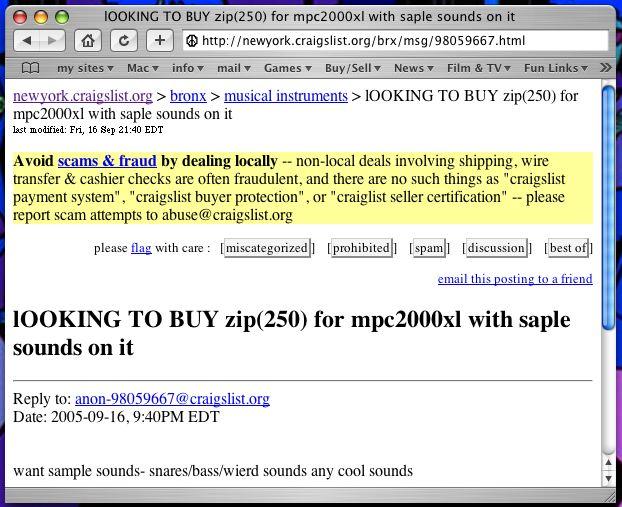
Most lowercase L's posted on this site are found in the real world, on the streets, in windows, handwritten on paper. That's why this virtual case of lowercase L, found on Craigslist, is especially unique. In addition to "saple" sounds, this fellow is apparently lOOKING TO BUY time by rushing through his Craigslist ad and posting without proofreading. My guess is that he forgot to press the caps lock key until after he had already typed the L. Too late, I'm not selling my saple zip disks to this freak.

Thursday, September 15, 2005

All a MAJOR cover-up


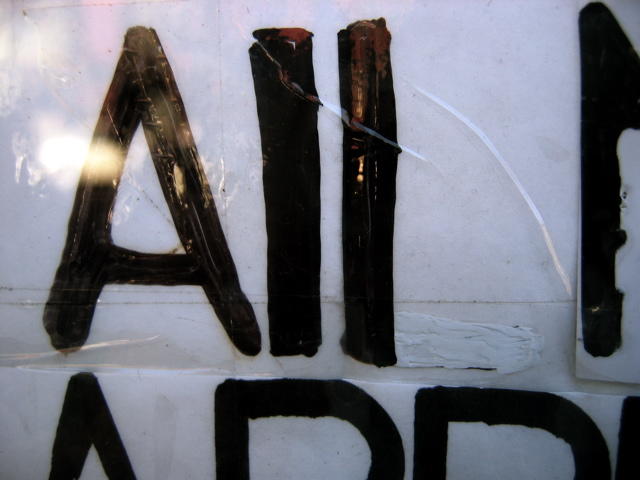
At first glance this sign found in the window of a 7th Ave. dollar store seems a typical case of lowercase L. WE CARRY All MAJOR APPLIANCE, simple enough. But upon further inspection, we find something very peculiar. Click on the close-up photo to the left to see a larger view. Notice the White-Out applied to what used to be the lower portion of an uppercase L. What could possibly explain this disturbing behavior? It seems the author had previously written the word ALL with at least one uppercase L. Perhaps the middle L was squeezed in after the final L was doctored to look lowercase? Did a second, deranged author surreptitiously modify this signage in an attempt to discredit the first author? And the word MAJOR was taped over whatever else used to be there, as well as the word APPLIANCE. This is all just too suspicious if you ask me. It's one big cover-up for the lowercase L conspiracy that is emerging right under our noses.

I urge you to send in more examples so that we may learn from example and understand this threat to society. But be cautious, trust no one.

Sunday, September 11, 2005

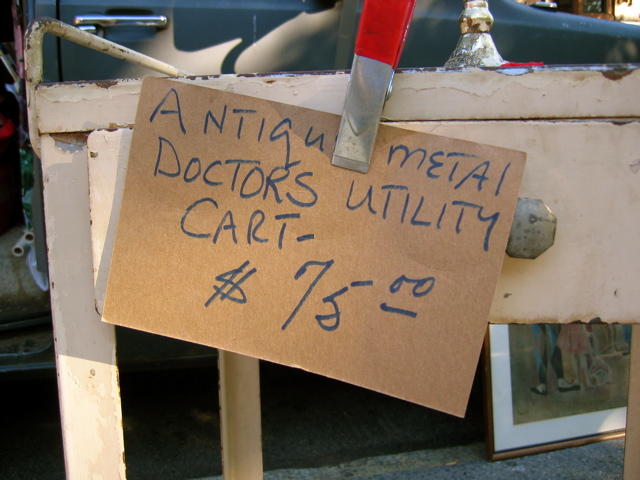
Muddled METAl


I was almost going to buy this antique METAl doctor's utility cart, spotted at the 7th Ave. Park Slope flea market. But when I noticed the out-of-place lowercase L on the tag, I decided against it. I do not trust people who misuse lowercase L's like that, and I wouldn't be surprised if this utility cart never actually belonged to an antique metal doctor.

Monday, September 05, 2005

Everything is under CONTROl


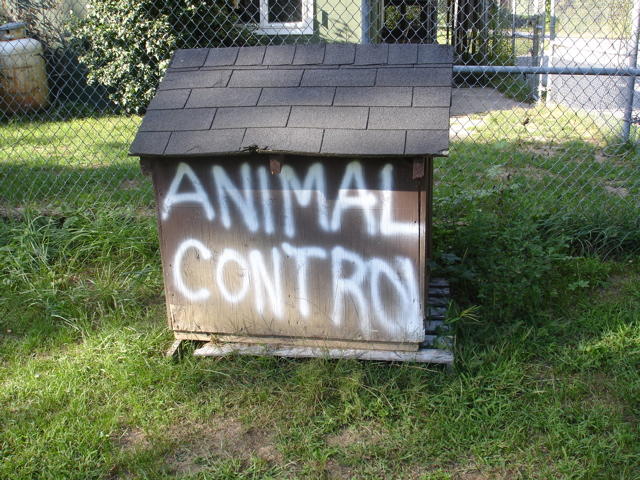
Yet another fine submission from our New England reporter, Spinning Girl, this dog house with ANIMAL CONTROl spray painted on its side was spotted outside a kennel in New Milford, CT. At first glance this appears to be a case of poor planning, the author having run out of space before completing his final uppercase L. But I think a more reasonable explanation is that the person who wrote this sign was bitten by a rabid animal--just one of the occupational hazards of animal control--and is now exhibiting the first signs of dementia brought on by the gradual shutdown of the central nervous system. Ending an all uppercase word with a lowercase L is a clear symptom of rabies. Citizens of New Milford, be on the lookout for a rabid animal control zombie carrying a spray paint can, probably attempting to eat your brains.

Tuesday, August 23, 2005

Another L lOCATED!

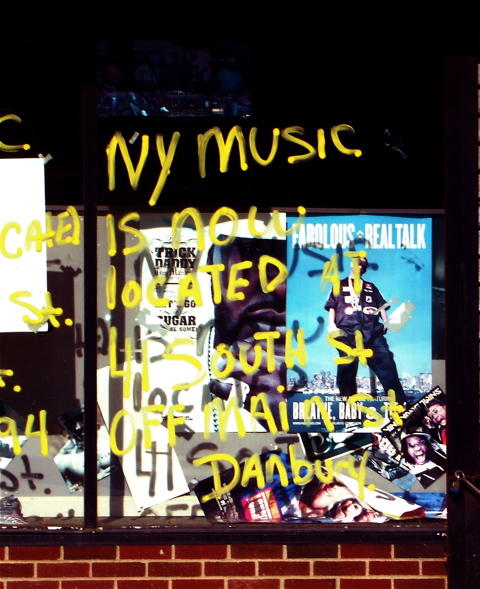
Spinning Girl submits this fine lowercase L specimen found in Danbury, Connecticut, where, according to the window dressing, NY music is now lOCATED. And I had been wondering where it went, it's been so quiet here in Brooklyn!

Sometimes the randomly placed lowercase L seems to have no logic, but I may be able to explain the thought process behind this one. I think that the window dresser started writing "located" in all lower case, but by the time he hit "c", he forgot that he was writing in lowercase letters (since the lowercase "o" and "c" are just mini versions of their uppercase counterparts). So he finished the word with uppercase letters.